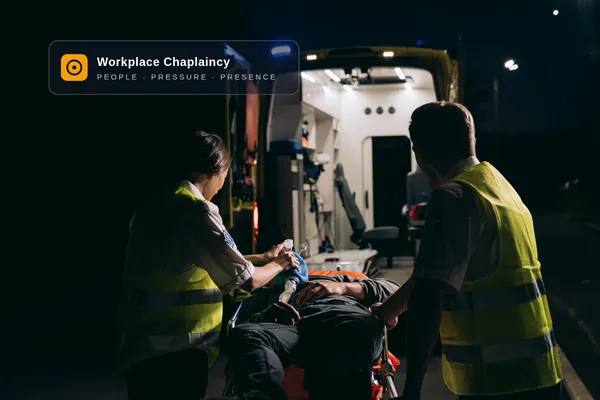
When the Siren Fades: The Importance of Chaplaincy for Canada's Emergency Response Industries
“The question is never whether they will be affected; it is whether they will be adequately supported when they are.”
Every day, across every province and territory in Canada, tens of thousands of men and women race toward the emergencies that everyone else runs from. Police officers step into domestic violence situations and arrive at murder scenes. Firefighters enter burning buildings, pull victims from crushed vehicles, and kneel in the rubble of collapsed structures. Paramedics hold the hands of the dying on the shoulder of a highway. Emergency dispatchers listen to the sounds of tragedy through a phone line they cannot escape. These are Canada's first responders, and the weight they carry does not disappear when the siren fades.
The mental and spiritual toll of emergency response work is staggering in its scale and often invisible in its expression. Research by the Canadian Mental Health Association estimates that traditional first responders experience post-traumatic stress disorder (PTSD) at twice the rate of the general population. Suicide, substance abuse, depression, anxiety, broken relationships, and early career departure are all disproportionately prevalent in the emergency services sector. The cumulative trauma of years spent at the intersection of human tragedy does not simply wash off at the end of a shift. It accumulates, quietly, until it becomes something that clinical language struggles to fully describe.
In response to this crisis, a growing number of Canadian emergency service agencies have turned to an ancient institution for very modern help: the chaplain. This blog explores the history, role, and critical importance of chaplaincy in Canada's emergency response industries, examining how the ministry of presence is becoming an indispensable pillar of first responder wellness, and why the conversation about mental health in emergency services is incomplete without it.
Understanding Emergency Services Chaplaincy
The word "chaplain" originates from the Latin cappa, meaning a hooded cloak or cape, and the concept of a chaplain as a spiritual and pastoral caregiver within closed, high-stress communities has existed for centuries. Historically, chaplains have ministered within militaries, hospitals, and prisons, communities where individuals are separated from their normal support networks and routinely encounter suffering, death, and moral complexity. In recent decades, first responder services have been increasingly recognized as belonging to that same category of institutional need.
First responder chaplaincy is a form of ministry focused specifically on assisting police officers, firefighters, paramedics, emergency medical technicians, 911 dispatchers, and other emergency personnel. Chaplains in this context provide emotional and spiritual support to these first responders, helping them better manage the extraordinary psychological demands of their work. They also offer direct support to the families of first responders, particularly in cases of line-of-duty injury or death, and to community members affected by tragedy. At its core, emergency services chaplaincy is about building deep relationships of trust and being present: sometimes doing nothing more than sitting with someone in the darkness of their distress, and doing so without judgment, agenda, or clinical distance.
Crucially, the modern emergency services chaplain is not simply a religious minister who shows up to say prayers. Rooted in the Christian tradition of selfless service and compassionate care, the chaplain draws on pastoral skills, emotional intelligence, trauma-informed care, and genuine human solidarity to meet first responders where they are, bringing the ministry of presence to bear in the most demanding moments of their professional lives.
The Mental Health Crisis in Canadian Emergency Services
To understand why chaplaincy matters so urgently in Canadian emergency services, one must first understand the scale and depth of the mental health crisis affecting these workers. The Government of Canada formally acknowledged the severity of the issue through its national strategy, "Supporting Canada's Public Safety Personnel: An Action Plan on Post-Traumatic Stress Injuries," which identified risk mitigation, diagnosis, and treatment as national priorities.
In Ontario, the government passed the Supporting Ontario's First Responders Act in April 2016, creating a legal presumption that PTSD diagnosed in first responders is work-related. This landmark legislation acknowledged what first responders had long known but often felt unable to say: that their work carries a profound psychological cost, and that this cost constitutes a legitimate workplace injury deserving of institutional support. A report from the City of Toronto on PTSD and Suicide Prevention for First Responders noted that occupational groups subject to frequent traumatic events are vulnerable to anxiety, depression, PTSD, substance abuse, and suicide risk, and that first responders are at least twice as likely as the general population to develop PTSD. Research consistently demonstrates that police officers, firefighters, and paramedics are exposed to potentially traumatic events, including murders, physical assaults, fatal accidents, child deaths, and mass casualty situations, on a routine basis. Without effective support systems, this repeated exposure becomes cumulative, eroding resilience, destabilizing personal relationships, and fostering an internal culture of suffering in silence.
A 2024 report by the National Police Federation described escalating mental health injuries among RCMP officers, painting a picture in which years of accumulated trauma, administrative pressure, and inadequate support had created a mental health emergency within the force itself. The situation is mirrored across fire services, paramedic services, and emergency communications centres. Research published in Stress, Prevention, and Resilience among First Responders confirmed that first responder careers carry significant potential for burnout, PTSD, suicide risk, and a range of other mental health challenges due to the inherent demands of the work.
It is into this landscape, one that clinical systems alone have not been fully equipped to address, that the chaplain steps. The chaplain offers something that neither a psychologist with a mandatory reporting requirement nor a peer support worker with institutional ties can always fully provide: complete confidentiality, unconditional presence, and the willingness to engage with the spiritual and existential dimensions of suffering that clinical models sometimes leave untouched.
A Brief History of Emergency Chaplaincy in Canada
The formal history of emergency services chaplaincy in Canada is relatively recent compared to its military counterpart, but its roots are deeply connected to the same tradition of ministry in high-risk, closed communities. The Salvation Army, which has a long-standing chaplaincy history stretching back to the Men's Social Services in the United Kingdom in the late 1890s, was among the early proponents of crisis chaplaincy in Canada, appointing chaplains during the First World War for both Canadian and Australian forces. This groundwork helped to establish and normalize the idea of chaplains as crisis responders rather than simply parish ministers.
In North America, the formal organization of fire service chaplaincy emerged in June 1992, with the establishment of the Federation of Fire Chaplains, an organization incorporated to bring together individuals and groups providing effective chaplaincies for fire service organizations, with the explicit goal of providing aid and comfort to firefighters and their families, as well as to victims of fires and other crises. In Canada, this movement took institutional shape through the Association of Fire Chaplains, whose mission is to bring together chaplains in service of firefighters and their families, to work toward the betterment of all areas of the fire and emergency service, and to "achieve a single healing, unifying spirit of love for God and each other." The Association reflects the distinctly Canadian character of the movement, simultaneously rooted in faith, shaped by community, and oriented toward practical, hands-on service.
Police chaplaincy programs grew across Canadian jurisdictions over the following decades as police services began to recognize that the unique psychological and spiritual challenges faced by officers required specialized pastoral support that Employee Assistance Programs and Human Resources departments were not designed to provide. Today, chaplaincy programs can be found in police services, fire departments, paramedic services, and emergency dispatch centres across Canada, from urban centres to rural communities, and the profession is in the process of active growth and formalization.
The Role of the Fire Service Chaplain
In the fire service, the role of the chaplain has evolved considerably from any purely religious function. As described by Fire Engineering magazine, the fire chaplain today operates more like a counsellor than a religious advocate, called upon to support people in moments of profound personal and professional crisis. Their presence at emergency scenes brings a quality of calm and humanity to what are frequently chaotic and emotionally overwhelming environments. Fire Engineering describes a striking and instructive scene: "I have witnessed some of the most burly and rugged firefighters remove their helmets and bow their heads when the chaplain enters a burned-out room to administer last rites to a fire victim. This simple gesture seems to place some perspective into the loss of a human life at that fire. It serves at once the needs of the firefighters and the deceased fire victim."
This dual function, serving both the responder and the community member in crisis, is one of the defining features of fire chaplaincy. Fire chaplains in Canada provide pre-incident pastoral availability, ensuring that firefighters have an established, trusted relationship with a chaplain before a crisis demands it. During incidents, they provide on-scene emotional support to both responders and victims' families. And in the aftermath of critical incidents, particularly those involving the death of a child, a mass casualty event, or the injury or death of a firefighter, they play a central role in Critical Incident Stress Management (CISM) and early intervention.
The Muskoka Lakes Fire Department's policy guidelines explicitly identify the chaplain as a key component of their CISM framework, listing specific situations where chaplain support should be deployed: incidents involving the direct injury or death of a firefighter; situations where a victim or family is "highly emotional or unstable"; cases where emotional care is needed for a family while an emergency is still underway; or any incident where the Incident Commander judges that "the presence of the Chaplain would be of benefit to the victim or department personnel." This institutionalization of the chaplain within the operational structure of the fire service is a powerful indicator of how seriously Canadian fire departments have come to take the role.
Police Chaplaincy and the Trust Gap
Police chaplaincy in Canada has developed into a structured and increasingly valued component of officer wellness programming. Research characterizes chaplaincy programs as a "unique and specialized form of support" for police officers who are routinely exposed to potentially traumatic events on a day-to-day basis. Studies reviewing staff perceptions of chaplaincy in first responder and military settings have found that police officers particularly value chaplains for both their pastoral support and their on-scene presence during difficult operational situations, including death notifications, suicide calls, and child casualty events.
A key distinction that makes police chaplaincy uniquely effective is the element of trust born from independence. Chaplains are not supervisors, not psychologists with mandatory reporting obligations, and not union representatives with institutional agendas. They occupy a singular relational space that allows officers to speak honestly about their struggles, including guilt, moral confusion, anger, grief, and fear, without professional consequence. The Government of Canada's 2021 review of the Royal Canadian Chaplain Service explicitly highlighted this characteristic, noting that chaplaincy services contribute to stress reduction precisely by functioning as a "trusted source of support for emotional, personal, or spiritual issues."
Real-world examples of integrated police chaplaincy in Canada illustrate the growing commitment to this model. The Edmonton Police Service has maintained an on-call chaplain program providing support to officers across all shifts and incidents. The Strathcona County RCMP and Enforcement has been served since March 2023 by chaplain Greg Hochhalter of Beam Support Services, a professional who brings both pastoral training and direct lived experience as a firefighter and emergency medical responder to his work, and who also serves the City of Edmonton's Trauma Response Team and Strathcona County Emergency Services. This integration of professional pastoral care with operational first responder experience represents a growing and compelling model for police chaplaincy across Canada.
Research examining police chaplains in Australia and New Zealand, with significant implications for the Canadian context, found that chaplains play an important role in supporting police members exposed to morally transgressive events, and recommended a holistic model of care that includes chaplaincy alongside organizational support structures and access to evidence-based mental health treatment. The availability of chaplains across police services, the study noted, and the close alignment between the support chaplains offer and the support that officers actually seek, demonstrates that they occupy an important and difficult-to-replace role.
Chaplaincy and Moral Injury
One of the most compelling arguments for chaplaincy in emergency services is its unique capacity to address moral injury, a concept distinct from PTSD that has gained significant traction in both military and first responder research. Moral injury refers to the lasting psychological, spiritual, and existential harm caused by participating in, witnessing, or failing to prevent events that violate one's deeply held moral beliefs or sense of purpose. For first responders, this can include being unable to save a child despite doing everything right, being ordered to take actions that conflict with their conscience, witnessing systems of injustice they feel powerless to address, or carrying private guilt over split-second decisions made in impossible circumstances.
Standard psychological interventions for PTSD are not always adequate for moral injury, because moral injury is fundamentally a wound to the meaning-making framework through which a person understands themselves, their actions, and their place in the world. It is a wound to identity, not only to psychological functioning. This is precisely where chaplaincy offers something genuinely distinctive. As research published by the National Institutes of Health notes, "spiritually integrated psychotherapies, as well as chaplain-facilitated pastoral care approaches, may be effective adjuncts or alternatives for addressing moral injury," adding that the potential benefits of these approaches are associated with their capacity to address the spiritual dimensions of moral transgression in ways that purely clinical models may not reach.
For a firefighter haunted by the face of a child they could not save, or a police officer silently wrestling with what they had to do to survive a violent confrontation, the chaplain does not offer a diagnosis or a treatment protocol. They offer something older and perhaps more necessary: a companion willing to sit in the darkness without flinching, to hold space for grief and guilt, and to help a person find their way back to a sense of meaning, forgiveness, and human wholeness.
Faith as Foundation: The Christian Roots of Emergency Chaplaincy
The chaplaincy tradition in Canadian emergency services is rooted, at its core, in the Christian understanding of service, compassion, and sacrificial care for others. The word "Padre," used warmly across both military and emergency services contexts, carries within it a heritage of priestly and pastoral ministry that stretches back through centuries of Christian service to those in need. From the Salvation Army's earliest chaplaincy deployments during the First World War to the fire service chaplains who administer last rites in the smoking ruins of a tragedy, the Christian call to bear one another's burdens has been the animating spirit of this work.
The Association of Fire Chaplains captures this spirit in its mission, calling on chaplains to "achieve a single healing, unifying spirit of love for God and each other." That language, drawn from the wellspring of Christian tradition, reflects what pastoral care in emergency services has always been at its most authentic: not a clinical procedure or an institutional policy, but an act of love, rooted in faith, offered freely and without condition. Emergency chaplains ordained or commissioned by Christian denominations bring to their work not only professional training, but a theological understanding of suffering, redemption, forgiveness, and the enduring worth of every human life. This framework equips them uniquely to companion first responders through the moral and existential terrain of their work.
This Christian foundation does not limit the chaplain's ministry; rather, it deepens and sustains it. The Gospel imperative to serve the stranger, to sit with the suffering, and to proclaim the worth of every soul regardless of station or circumstance is precisely what enables the chaplain to serve with genuine, uncalculating compassion. It is a tradition of presence that does not require the other person to share its beliefs in order to benefit from its care, and it is this quality, more than any institutional credential, that has made Christian chaplaincy so trusted and so valued in Canada's emergency services community.
The Future of Emergency Chaplaincy in Canada
The trajectory of emergency services chaplaincy in Canada is one of growth, professionalization, and deepening institutional integration. Agencies across the country are increasingly formalizing their chaplaincy programs, developing training standards, establishing deployment protocols, and building regional networks capable of providing rapid, coordinated response to large-scale critical incidents. Organizations like the Association of Fire Chaplains and community-embedded services like Beam Support Services in Edmonton are helping to define what professional, evidence-informed, operationally integrated chaplaincy can look like in the Canadian context.
Legislative momentum is also building. As provincial governments continue to grapple with the mental health and disability crisis among first responders, chaplaincy is gaining recognition as a cost-effective, culturally trusted, and holistically oriented component of wellness programming that complements, rather than competes with, clinical mental health services. Unlike many clinical interventions, chaplaincy operates with minimal barriers to access. There are no referrals required, no waiting lists, no intake assessments, and, critically, no stigma attached to reaching out to the Padre for a conversation. It is, at its best, simply a trusted colleague who is always available, always present, and never keeping score.
As awareness of first responder mental health continues to grow in Canada, and as the field of chaplaincy itself continues to professionalize, there is every reason to believe that the chaplain's role in emergency services will deepen and expand. The need, after all, has never been in question. What is changing is the willingness to acknowledge it, and to invest in the people and programs that answer it.
Conclusion
The siren may fade, but the images, sounds, and moral weight of emergency work do not. For the men and women who staff Canada's police services, fire departments, paramedic services, emergency dispatch centres, and search-and-rescue teams, cumulative trauma is not a hypothetical occupational risk; it is a near-certainty. The question is never whether they will be affected; it is whether they will be adequately supported when they are.
Emergency services chaplaincy in Canada represents a vital and growing answer to that question. Rooted in a tradition of pastoral care that stretches back centuries, and adapted with remarkable intelligence and compassion to the specific culture of modern first response, the chaplain occupies a unique and irreplaceable position within the broader ecosystem of first responder wellness. They are present in the moments that no one else can quite reach: on the scene of a mass casualty, in the quiet corner of a fire hall where someone is silently coming apart, in the hospital waiting room where a family needs someone to simply be there and to mean it.
In a profession defined above all else by showing up, chaplains show up for the people who show up for the rest of us.
Workplace Chaplaincy helps employers offer compassionate, confidential support through a familiar, trusted presence, supporting employees in navigating stress, grief, family challenges, and difficult transitions.
Our permission-based care welcomes people of every belief and works alongside leadership, HR, and existing employee resources. Serving Central Alberta in person and offering virtual support nationwide, we help you build a workplace where people feel supported, not just employed.
Explore Workplace Chaplaincy and discover how we can support your team.
Sources:
Canadian Mental Health Association, cited in McGlinchey, D., et al. "Protocol for a study on the mental health and well-being of 'Forgotten' first responders in Canada." PLOS ONE (2023).
Carey et al. (2016), cited in Tunks Leach, K., et al. "Staff perceptions of chaplaincy in first responder and military settings." University of Technology Sydney (2020).
UCF RESTORES. "Chaplaincy Overview - BHAP Toolkit."
Government of Canada, "Supporting Canada's Public Safety Personnel: An Action Plan on Post-Traumatic Stress Injuries," cited in McGlinchey et al. (2023).
City of Toronto. Report on Post-traumatic Stress Disorder & Suicide Prevention Mental Health Support for First Responders (2017).
Research compiled in Trent University. Police Chaplaincy Programs and Mental Health Study (2023).
National Police Federation. Behind the Badge: Revealing Escalating Mental Health Injuries Among RCMP Officers. Ottawa: National Police Federation, 2024. Cited in: Van Eerd, D., et al. Workplace Programs to Reduce Post-traumatic Stress Injuries Work Disability: First Responder Experiences. PubMed (2025).
Pietrzak, R.H., et al. "Stress, Prevention, and Resilience among First Responders." PMC (2023).
The Salvation Army USA. "Emergency Response Chaplaincy Program - History."
Fire Engineering. "A Ministry of Presence." February 25, 2025.
Association of Fire Chaplains Canada. "Mission Statement."
Trent University. Police Chaplaincy Programs and Mental Health Study (2023).
Muskoka Lakes Fire Department. Occupational Stress Injury / Mental Wellness Guideline: Chaplaincy and CISM Policy (OG218).
Tunks Leach, K., et al. University of Technology Sydney (2020).
Government of Canada Review of the Royal Canadian Chaplain Service (2021), cited in Trent University research (2023).
Beam Support Services. "About - Greg Hochhalter." & "Association of Fire Chaplains Canada"
Carey, L., et al. "Towards a Holistic Model of Care for Moral Injury: An Australian and New Zealand Investigation into the Role of Police Chaplains." PubMed (2023).
Litz, B., et al. "Moral injury and moral repair in war veterans: A preliminary model and intervention strategy." Clinical Psychology Review (2009), framework discussed in: Moral Injury, Chaplaincy and Mental Health Provider Approaches to Treatment: A Scoping Review. PMC (2022).
Moral Injury, Chaplaincy and Mental Health Provider Approaches to Treatment: A Scoping Review. PMC (2022). Ibid.
Canadian War Museum. In Their Own Voices - Historical Overview.