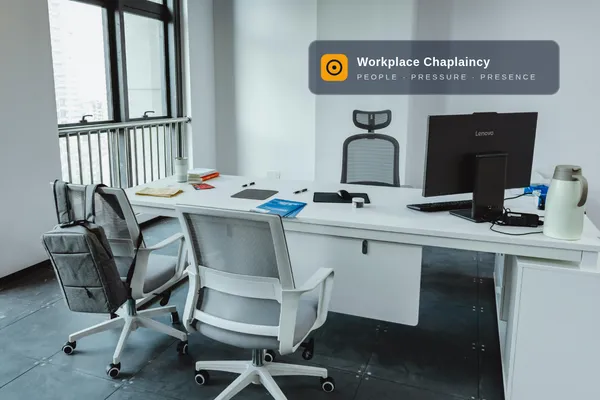
The Empty Chair: What Absenteeism Is Really Telling You About Your Workplace
“The popular narrative about workplace stress tends to locate its source at work: a difficult manager, a heavy workload, a toxic culture. Those things are real. But they tell an incomplete story.”
There is a chair somewhere in your organization that sits empty more than it should. Maybe it belongs to someone reliable, someone you would never have flagged as a concern six months ago. Maybe it has been a pattern long enough that you have started building around it without realizing you have.
You have filled out the paperwork. You have had the conversation. You may have even brought in the right HR language to address it. But here is the question most organizations never quite get to asking: what is that empty chair actually trying to tell you?
Absenteeism is one of the most visible, measurable symptoms of an unwell workplace. It is also one of the most misread. Organizations tend to treat it as a conduct issue, a scheduling problem, or at best a benefits utilization question. Very few treat it as what it most often is: a signal that something in the life of an employee has gone unaddressed long enough to pull them physically away from work.
That distinction is the difference between managing a symptom and addressing a cause. And the gap between those two responses is where the real cost lives.
The Numbers Behind the Empty Chair
Absenteeism in Canada is not a fringe issue. It is a structural one.
The Canadian Mental Health Association has estimated that mental illness alone accounts for 30 percent of short and long-term disability claims in Canada, and that at any given time, at least 500,000 Canadians miss work each week due to mental health challenges. The economic weight of that absence lands somewhere in the range of 50 billion dollars annually when lost productivity, replacement staffing, and cascading team effects are factored in.
Those numbers are large enough to feel abstract. They become concrete when you look at what is happening inside individual organizations. The average Canadian employee loses approximately nine to twelve days per year to unplanned absence. In industries with higher physical or emotional demands, that figure climbs significantly. And when you account for the management time spent covering for absences, the overtime paid to other employees, the reduced quality of output from teams running short, the real cost per absent employee can reach several multiples of their daily wage.
None of that includes what researchers call presenteeism, which is arguably the larger problem. Presenteeism is when an employee shows up but cannot fully function. They are in the chair. The chair is not empty. But the person occupying it is somewhere else entirely, distracted by financial strain, quietly managing grief, carrying the weight of a relationship in crisis, or running on so little emotional reserve that meaningful contribution is simply not available to them. Studies in occupational health have consistently found that the productivity cost of presenteeism exceeds the cost of absenteeism. You can measure an empty chair. An occupied one that produces nothing is much harder to see on a spreadsheet.
What Is Actually Driving People Away
The temptation, when absenteeism rises, is to look for the workplace explanation. A difficult manager. A heavy workload. A toxic team dynamic. Those things are real, and they deserve attention. But they tell a partial story.
Research into the causes of chronic absenteeism points repeatedly to a set of pressures that originate outside the workplace and follow employees through the door. Financial stress is one of the most consistent predictors. When a person is managing debt, navigating an unexpected expense, or watching the gap between income and cost of living widen, the cognitive load is enormous. It does not pause during work hours. It competes directly with focus, decision-making, and emotional regulation. Studies in occupational psychology have linked financial strain to both increased absenteeism and measurably reduced performance among employees who do show up.
Family tension operates the same way. A difficult marriage, a struggling teenager, a parent whose health is declining, these are not inconveniences that employees leave in the parking lot. They are ongoing realities that occupy mental and emotional space throughout the working day. Grief compounds this further. Workplace bereavement policies typically offer a handful of days for immediate family loss, as if grief has a schedule. In practice, the research on grief and productivity shows that its effects on concentration, motivation, and emotional availability can persist for months or years.
Then there are the quieter pressures that rarely get named at all. Loneliness. A sense of meaninglessness. Anxiety about the future that has no single identifiable source. These are the internal struggles that employees carry without a vocabulary to describe them, often without anyone to describe them to, and they erode attendance just as steadily as any diagnosable condition.
The common thread across all of it is not the nature of the pressure. It is the absence of anywhere safe to put it.
The Infrastructure Problem Nobody Is Talking About
Organizations have not ignored employee wellbeing. Most medium and large employers in Canada have invested in some version of support infrastructure. Employee Assistance Programs are the most common offering. Wellness platforms, mental health days, and flexible work arrangements have become standard talking points in recruitment and retention conversations.
The problem is not that these programs exist. The problem is that they were built around a model of care that assumes employees will self-identify a problem, seek out a resource, and navigate an intake process when they are at their most vulnerable. That model works for a narrow band of employees. For the majority, the gap between needing support and accessing it is wide enough that they never cross it.
Canadian research on EAP utilization has found average usage rates that hover well below ten percent of eligible employees. The most frequently cited barriers are not what benefits administrators tend to expect. Employees report uncertainty about confidentiality, skepticism about whether the program will actually help, and most consistently, a preference for someone they already know and trust. Not a call center. Not an anonymous intake form. A person.
That preference is not irrational. It is rooted in how human beings actually process difficulty. When something goes wrong, people do not reach for a program. They reach for a relationship. They reach for the person who already knows their name and has been present on ordinary days, not just the bad ones. The reason most support infrastructure goes unused is not stigma alone, though stigma remains real. It is that the infrastructure was built for efficiency, and human beings in crisis do not run on efficiency.
The Cost Nobody Is Calculating
The financial cost of absenteeism is the number organizations are most likely to track. It is measurable, reportable, and easy to include in a quarterly review.
What is harder to calculate, and considerably more expensive over time, is the cultural cost.
When a team member is chronically absent, the people around them absorb the difference. They cover extra shifts. They manage additional tasks. They carry the emotional labour of not knowing what is happening or when it will change. Over time that accumulated weight produces its own absenteeism. It produces quiet disengagement, the kind that precedes resignation letters. It produces a culture where people feel unseen, where the message received is that the organization's primary relationship with employees is transactional, and that when things get hard, the available response is a phone number and a policy document.
Retention research makes this dynamic visible. Study after study in organizational behaviour has found that employees leave not primarily because of compensation or workload, but because of how they feel inside the culture. Specifically, they leave when they do not feel that the people around them genuinely care about them as people. The inverse is equally true. Employees who feel that their organization invests in their wellbeing as human beings, not just as productive units, stay longer, engage more fully, and produce measurably better work.
The chair stays occupied. And the person in it is actually there.
When Silence Becomes the Strategy
There is a particular kind of organizational culture that treats employee struggle as a private matter. The unspoken rule is: we provide the benefits, you manage your life, and we will meet in the middle at performance. It is a clean model on paper. It produces clean dysfunction in practice.
The employees most likely to become chronically absent are often the ones least likely to raise their hand. They are competent, conscientious, and proud. They do not want to be seen as a problem. They have spent months or years quietly managing whatever they are managing, absorbing the cost personally, until the moment they cannot. And by the time that moment arrives, the visible absence is the last stage of a long, invisible process that nobody interrupted because nobody knew it was happening.
This is the architecture of a preventable crisis. And it is repeated in workplaces across Canada every week, not because organizations do not care, but because they do not have a model that reaches employees before the breaking point.
Building a culture of genuine care does not require a new technology platform or an expanded benefits package. It requires a human presence that shows up before it is urgently needed, that builds relationships in the ordinary weeks so that the extraordinary ones have somewhere to go.
What Presence Actually Changes
The research on what reduces absenteeism is more consistent than the range of proposed solutions might suggest. Across sectors, organization sizes, and employee demographics, the factor that most reliably reduces unplanned absence is not a specific program. It is the quality of the relational environment employees experience at work.
Employees who feel genuinely seen and supported by the culture around them are less likely to disengage, less likely to be absent, and more likely to bring their full capacity to the work in front of them. That relational environment is not built by policy. It is built by people. By the consistent, unhurried presence of someone whose role is to pay attention, to check in without a performance agenda, and to provide a safe place for the things that employees are carrying but not saying.
This is not a therapy function. It is not a clinical or diagnostic role. It is something older and in many ways more fundamental: a trusted person who shows up, who knows the names and the context and the ordinary texture of people's lives, and who is present when something changes. Someone who can sit with a person in a hard moment without needing to fix it, escalate it, or file a report about it.
The effect of that kind of presence on a workplace is difficult to overstate. It changes the fundamental experience of work from transactional to relational. It communicates, through action rather than policy, that the organization's relationship with its employees extends to the whole person, not just the productive one. And it creates a channel for the struggles that currently go silent, draining attendance and engagement, to find a safe landing place before they become a crisis.
Try This This Week
The next time you see an absenteeism trend in your organization, resist the instinct to address it purely as a conduct or compliance matter. Before the conversation about attendance policy, ask a different question: what might this person be carrying that they have nowhere to put?
You do not need to know the answer. You need to be the kind of leader who asks.
If you lead a team, try this: think of one person who has been absent more than usual, or who has been present but clearly somewhere else. Before the end of the week, find five minutes to check in with them. Not as a performance conversation. As a human one. Ask a genuine question and then stop talking.
Notice how much that small act costs you. Notice whether there is anywhere for the answer to go if they actually give it.
That gap, between the question and a container for the answer, is exactly where absenteeism lives. And it is exactly the gap that the right relational infrastructure is built to fill.
The empty chair is not a discipline problem. It is a distance problem. The question worth sitting with is this: in your workplace, how close is anyone actually getting to the people who are struggling before they stop showing up?
Workplace Chaplaincy helps employers offer compassionate, confidential support through a familiar, trusted presence, supporting employees in navigating stress, grief, family challenges, and difficult transitions.
Our permission-based care welcomes people of every belief and works alongside leadership, HR, and existing employee resources. Serving Central Alberta in person and offering virtual support nationwide, we help you build a workplace where people feel supported, not just employed.
Explore Workplace Chaplaincy and discover how we can support your team.
Sources:
Canadian Mental Health Association: Mental Illness and the Economy, 2024
Conference Board of Canada: Mental Health and Absenteeism in the Workplace, 2023
TELUS Health: Mental Health Index, Q1 2026
Statistics Canada: Work Absence Statistics, 2024
Journal of Occupational and Environmental Medicine: Financial Stress and Workplace Productivity, 2023
International Journal of Mental Health Promotion: Family Financial Stress, Psychological Depression and Physical Exhaustion in Employees, 2025
PLOS Mental Health: Barriers to EAP Utilization in Canada and the US, 2024
Journal of Occupational Health Psychology: Presenteeism and Productivity Loss in Canadian Workplaces, 2023